
Owning a historic brownstone in Back Bay, a classic triple-decker in Dorchester, or a century-old commercial storefront along Newbury Street comes with undeniable architectural charm, yet managing the aging infrastructure hidden behind plaster and brick walls requires extreme care when selecting an electrical contractor boston ma property owners can genuinely trust. Older buildings across Greater Boston frequently house legacy wiring systems, undersized service panels, and decades of patchwork renovations that pose severe fire hazards and code compliance challenges if mishandled. Before signing a contract or allowing anyone to open a junction box, property managers and homeowners must conduct a thorough vetting process to ensure their chosen professional possesses the licensing, historic building experience, insurance protection, and diagnostic precision needed to modernize power systems safely without compromising structural integrity.
What Licenses and Credentials Should an Electrical Contractor in Boston Hold?
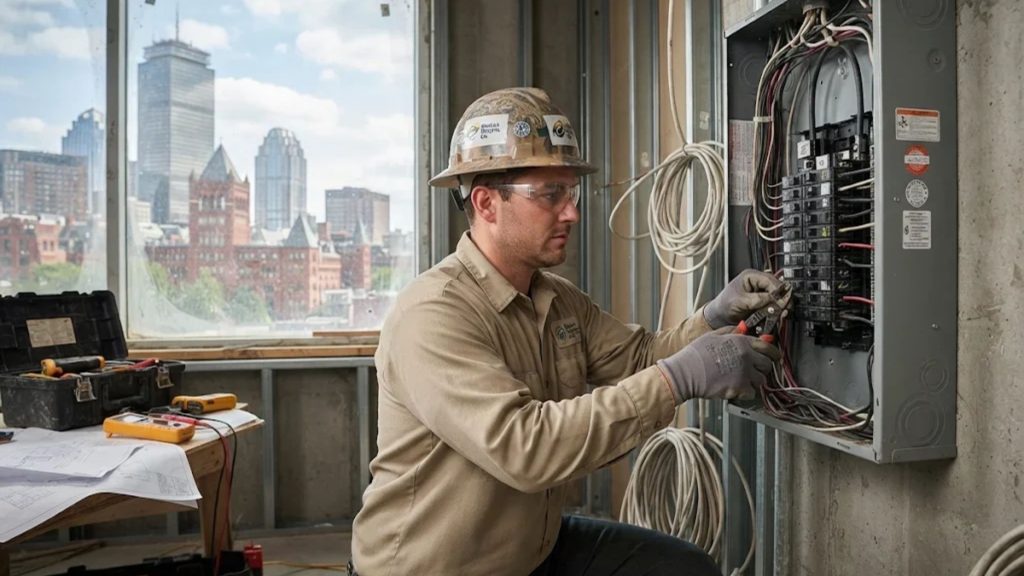
Every electrical contractor boston ma residents consider hiring must hold an active, verifiable Massachusetts Master Electrician License or operate under the direct supervision of a licensed Master Electrician registered with the Board of State Examiners of Electricians. In the Commonwealth of Massachusetts, electrical licensing is strictly tiered, meaning a Journeyman Electrician can perform installation work, while only a Master Electrician is legally authorized to pull permits, design complex electrical layouts, and contract directly with property owners for comprehensive system overhauls.
Verifying credentials goes far beyond glancing at a number printed on the side of a van or a business card. Property owners should directly cross-reference the contractor’s license number through the Massachusetts ePlace Portal to confirm that the license is active, free of disciplinary actions, and registered under the exact legal name of the contracting business.
- Master Electrician License (Class A): Authorizes the holder to plan, lay out, supervise, and install electrical wiring, apparatus, and equipment for light, heat, and power across residential and commercial properties.
- Systems Contractor License (Class C): Covers low-voltage systems such as fire alarms, security networks, and telecommunications infrastructure, which are vital in multi-unit Boston buildings.
- Massachusetts Home Improvement Contractor (HIC) Registration: Required for contractors performing residential remodeling work on existing one-to-four-family owner-occupied homes, offering property owners access to state arbitration and guaranty fund protections.
- OSHA Safety Certifications: Demonstrates that field technicians have completed rigorous workplace safety training, including arc flash awareness and lockout/tagout procedures for live commercial panels.
Why Does Specialized Experience with Historic Boston Architecture Matter?
Boston possesses some of the oldest residential and commercial building stock in the United States, meaning an electrician accustomed only to modern suburban stick-built construction will quickly encounter unfamiliar obstacles inside a nineteenth-century property. Working inside horsehair plaster walls, brick masonry, post-and-beam framing, and narrow urban utility chases demands specialized fishing techniques and surgical precision to route new copper conductors without destroying irreplaceable crown molding or historic wainscoting.
Furthermore, older buildings across neighborhoods like Beacon Hill, the South End, Charlestown, and Cambridge often fall under strict local historic district commissions. A contractor experienced in electrical services for older buildings understands how to position exterior meter sockets, disconnect switches, conduit runs, and historic lighting fixtures so they satisfy both modern safety regulations and preservation guidelines.
| Legacy Wiring or System Type | Era Commonly Found in Boston | Primary Safety & Operational Risks | Recommended Modernization Approach |
| Knob-and-Tube (K&T) Wiring | 1880s to 1930s | Brittle cloth insulation, lack of equipment grounding conductor, overheating when covered by modern attic insulation | Complete circuit decommissioning and replacement with modern grounded NM-B or armored MC cable |
| First-Generation Armored Cable (BX) | 1920s to 1950s | Deteriorating rubber wire insulation inside metal sheathing, unreliable grounding path through aging steel spiral | Full inspection of junction boxes and replacement of compromised branch circuits |
| Single-Strand Aluminum Wiring | Mid-1960s to Mid-1970s | Thermal expansion and contraction causing loose terminal connections, oxidation, and high risk of electrical fires | Whole-home copper rewiring or COPALUM/AlumiConn pigtailing by certified technicians |
| 60-Amp Fuse Boxes & Split-Bus Panels | Pre-1960s | Insufficient amperage for modern HVAC, EV chargers, and appliances; improper fuse oversizing by previous occupants | Service entrance upgrade to a 200-amp or 400-amp circuit breaker panel with whole-building surge protection |
How Do You Evaluate Their Approach to Diagnostic Testing and Safety Inspections?
A trustworthy contractor never guesses what is happening behind your walls or offers a ballpark quote over the phone for an aging structure. Before recommending any upgrades, a qualified professional will conduct a comprehensive electrical wiring inspection Boston building owners can rely on to uncover hidden code violations, overloaded neutral wires, and deteriorated insulation.
During an initial walkthrough, pay close attention to the diagnostic tools and methodology the electrician uses. Experienced professionals utilize thermal imaging cameras to detect hidden hot spots inside breaker panels, circuit analyzers to measure voltage drop and ground impedance, and borescopes to inspect concealed wall cavities with minimal drywall or plaster disruption.
- Load Calculation Analysis: The contractor should perform a formal National Electrical Code (NEC) Article 220 load calculation rather than merely matching the size of your existing panel, factoring in future plans for heat pumps, induction ranges, or commercial machinery.
- Grounding and Bonding Verification: Older Boston properties frequently rely on corroded metal water pipes for grounding, which becomes dangerously ineffective once municipalities or plumbers replace lead service lines with plastic PEX or PVC piping.
- Arc-Fault and Ground-Fault Assessment: A thorough evaluator will identify where modern AFCI (Arc-Fault Circuit Interrupter) and GFCI (Ground-Fault Circuit Interrupter) protection is missing in kitchens, bathrooms, basements, and sleeping areas.
- Subpanel and Shared Meter Audits: In multi-family triple-deckers and mixed-use buildings, electricians must verify that common area hallway lighting, boiler controls, and laundry circuits are properly separated from individual tenant meters.
What Insurance Coverage and Liability Protections Are Non-Negotiable?
Electrical work inside densely packed urban buildings carries inherent risks, making comprehensive insurance coverage an absolute requirement before any technician steps onto your property. In neighborhoods where brownstones share structural party walls and commercial storefronts sit directly beneath residential condominiums, a single wiring mistake or accidental fire can cause catastrophic multi-unit property damage.
Never accept a verbal assurance that a company is insured. Always request an up-to-date Certificate of Insurance (COI) sent directly from the contractor’s insurance agency, naming you or your condominium association as an additional insured party for the duration of the project.
- Commercial General Liability Insurance: Should carry a minimum coverage limit of $1 million per occurrence and $2 million aggregate to protect your structure against accidental fire, water damage from drilling into pipes, or third-party bodily injury.
- Workers’ Compensation Insurance: Mandatory under Massachusetts law for any contractor with employees, ensuring you cannot be held financially liable if an electrician is injured on a ladder or suffers a shock on your premises.
- Commercial Auto and Tool Coverage: Confirms the company operates as a legitimate, established enterprise with properly registered service vehicles and commercial equipment.
How Does the Contractor Handle Massachusetts Electrical Code Compliance and Permits?
Massachusetts enforces its own rigorous version of the National Electrical Code, known as 527 CMR 12.00 (the Massachusetts Electrical Code), which includes state-specific amendments governing wiring methods, grounding, and smoke detector interconnections. Any contractor who suggests skipping the municipal permit process to save time or lower project costs is exposing you to massive legal, financial, and safety liabilities.
When you partner with an established team like Beacon Mechanical Service, every phase of permitting, rough-in inspection, and final sign-off with the Boston Inspectional Services Department (ISD) is handled transparently from day one. Unpermitted electrical work can void your property insurance policy, halt real estate closings, and force you to tear open newly finished walls so city inspectors can verify concealed wiring.
Navigating Utility Coordination with Eversource in Greater Boston
Upgrading the electrical capacity of an older Boston building almost always requires close coordination with Eversource, the regional electric utility provider. Replacing an outdated 60-amp or 100-amp overhead service drop or underground lateral feed involves scheduling utility disconnects, upgrading meter troughs to meet current Eversource specifications, and obtaining utility engineering approval for higher amperage loads.
An experienced local contractor already understands Eversource’s service territory rules, meter room clearance mandates, and lead times. They will manage the utility work order alongside the city electrical permit so your building is never left without power overnight due to administrative miscommunication.
What Should You Look for in a Written Estimate and Project Scope?
Vague, single-line estimates are one of the biggest red flags when hiring tradespeople for older properties. Because historic buildings often reveal unexpected conditions once walls or ceilings are opened, your written proposal must clearly define what is included in the base price and how unforeseen discoveries will be priced and approved.
A reputable provider of commercial electrical upgrades Boston and residential rewiring projects will present an itemized scope of work that breaks down labor, material specifications, permit fees, and cleanup responsibilities. Comparing detailed proposals allows property owners to evaluate true value rather than falling into the trap of accepting an artificially low bid that relies on cheap materials or hidden change orders.
| Contract Component | What a Transparent Proposal Includes | Warning Signs to Watch Out For |
| Material Specifications | Exact brands and ratings for breaker panels (e.g., Square D QO, Eaton CH), copper wire gauges, and commercial-grade receptacles | Generic phrasing like “new breakers and wire as needed” with no mention of copper vs. aluminum or panel brand |
| Wall & Plaster Access Plan | Clear explanation of where access holes will be cut, dust containment protocols, and whether plaster patching is included or excluded | No mention of how wires will be fished through finished plaster walls or who handles debris disposal |
| Permit & Inspection Fees | Explicit inclusion of municipal permit filing fees and attendance at rough-in and final ISD inspections | Asking the homeowner to pull the permit in their own name or claiming “permits aren’t needed for replacements” |
| Payment Schedule | Reasonable deposit (typically 25% to 33%), progress payment tied to rough-in inspection, and final balance upon city sign-off | Demands for 75% to 100% upfront payment before materials arrive on site |
| Workmanship Warranty | Written guarantee covering labor defects for at least one to two years alongside manufacturer equipment warranties | Verbal promises with no written warranty terms in the signed contract |
Why Is Integrated Mechanical and Electrical Expertise Valuable for Older Buildings?
In older Greater Boston homes and commercial facilities, electrical systems rarely operate in isolation from heating, cooling, ventilation, and plumbing infrastructure. Modernizing an aging property frequently involves transitioning away from legacy oil or gas boilers toward high-efficiency electric heat pumps, installing tankless water heaters, or adding backup power systems that require seamless coordination between multiple mechanical trades.
Working with a full-service company like Beacon Mechanical Service eliminates the friction and finger-pointing that often occur when separate plumbing, HVAC, and electrical subcontractors work on the same historic building. Property owners seeking reliable solutions can explore comprehensive electrical services in Greater Boston that align panel capacity upgrades directly with heating, cooling, and commercial equipment demands.
Preparing Aging Properties for Electrification and Modern Demands
Many Boston building owners are actively upgrading their properties to meet municipal energy efficiency benchmarks, qualify for Mass Save rebates, or attract modern commercial tenants. Installing Level 2 electric vehicle charging stations in shared parking areas, upgrading commercial kitchen exhaust hoods, and integrating smart building automation all place continuous high-amperage loads on electrical panels designed decades ago.
By reviewing your building’s holistic mechanical footprint, an integrated contractor ensures your new electrical service includes dedicated circuits, proper harmonic filtering, and spare breaker spaces for future expansion. Before committing to major infrastructure investments, learning more about our Greater Boston mechanical and electrical team helps property owners verify decades of local craftsmanship across both residential and commercial environments.
How Can You Verify Local Reputation, References, and Emergency Support?
Online star ratings provide a helpful starting point, yet evaluating a contractor’s true track record in older Boston buildings requires deeper investigation. Look for consistent reviews that specifically mention historic homes, knob-and-tube removal, commercial tenant build-outs, punctual communication, and clean job sites.
Ask prospective contractors for two or three recent local references from property owners whose buildings match the age and construction style of your own. Speaking directly with a fellow landlord, condo trustee, or business owner in neighborhoods like Brookline, Somerville, Quincy, or the South Shore reveals how the contractor handles surprises behind the walls and whether they stand behind their work long after the final invoice is paid.
- 24/7 Emergency Response Capabilities: Older electrical systems do not always fail during standard business hours; confirm whether the contractor offers round-the-clock emergency dispatch for burning smells, tripped main breakers, or storm-related service mast damage.
- Cleanliness and Dust Control: Lead paint and fine plaster dust are common in pre-1978 Massachusetts buildings, so verify that technicians use HEPA vacuums, drop cloths, and protective floor runners during interior work.
- Clear Communication Channels: Ensure you will have a dedicated point of contact who provides daily progress updates and explains technical options in plain, jargon-free language.
Property owners looking for a dependable partner across residential and commercial systems can visit Beacon Mechanical Service to review full-spectrum building maintenance capabilities. Taking the time to verify credentials, inspect diagnostic thoroughness, and review written contracts protects your investment and ensures your property operates safely for decades to come.
Frequently Asked Questions
How much does it cost to rewire an older house in Boston, MA?
Rewiring an older Boston single-family home or condo typically ranges from $8,000 to $25,000 or more, depending on square footage, the number of stories, and whether walls are constructed of horsehair plaster or drywall. Properties requiring complete knob-and-tube removal alongside a 200-amp service panel upgrade sit toward the higher end of that range due to the labor required to fish wires without damaging historic woodwork.
Do I have to replace knob-and-tube wiring in Massachusetts?
Massachusetts law does not automatically force homeowners to rip out intact knob-and-tube wiring simply because it exists, unless it is damaged, overloaded, or covered by thermal insulation. However, most homeowner insurance carriers in Greater Boston refuse to write or renew policies on properties with active knob-and-tube wiring, and modernizing it is essential for safely running contemporary appliances and electronics.
How long does an electrical panel upgrade take in an older Boston building?
A standard residential upgrade from an outdated 60-amp or 100-amp fuse box or breaker panel to a modern 200-amp service typically takes one full day, lasting roughly six to ten hours. Commercial multi-meter service upgrades or projects requiring Eversource underground trenching can take several days and require coordinated scheduling with utility engineers and city inspectors.
What are the warning signs that an older building needs an electrical inspection?
Common warning signs include flickering or dimming lights when large appliances turn on, frequently tripping circuit breakers, warm or discolored outlet faceplates, two-prong ungrounded outlets, crackling sounds near switches, and a faint burning odor near the main service panel. If your building is over 40 years old and has never undergone a professional electrical evaluation, scheduling a preventive inspection is strongly recommended.
Can an electrical contractor upgrade wiring in plaster walls without tearing down the entire wall?
Yes, experienced Boston electricians use specialized flexible drill bits, fish tapes, magnetic wire pullers, and compact camera scopes to route new cables through existing wall cavities and floor joists. While small, strategic access openings are occasionally required near corners or ceiling transitions, skilled technicians minimize plaster disruption and keep historic trim intact.
Partnering with a Trusted Electrical Contractor in Boston, MA
Choosing the right electrical contractor boston ma property owners can depend on is one of the most consequential maintenance decisions you will ever make for a historic home or aging commercial building. By confirming active Massachusetts Master Electrician credentials, verifying comprehensive liability insurance, demanding thorough diagnostic load calculations, and insisting on full ISD permitting, you eliminate the guesswork and safety hazards associated with legacy wiring systems.
Whether you are planning a proactive panel upgrade, resolving recurring circuit issues, or modernizing a multi-unit property for long-term efficiency, Beacon Mechanical Service brings proven local expertise, transparent pricing, and dedicated craftsmanship to every job across Greater Boston and the South Shore. If you are ready to evaluate your building’s wiring or schedule a free, detailed project estimate, you can easily schedule an electrical consultation with our team today to keep your property safe, compliant, and reliably powered.